🎥 AI Agents and MCP
Nubenetes V2 Elite Portal
You are browsing the AI-Curated V2 Elite Edition. Looking for the exhaustive list of references? Check out the V1 Historical Archive.
Welcome to the AI Agents and MCP section of the V2 Video Hub. Explore curated high-density videos with architectural summaries.
Red Hat OpenShift
🎬 Thursday morning general session - May 9 - Red Hat Summit 2019
Architectural Summary
This session outlines the architectural enablement of cloud-native AI/ML workloads by integrating Red Hat OpenShift with NVIDIA GPU acceleration and automated MLOps platforms like H2O.ai and ProphetStor. It demonstrates how standardizing on a Kubernetes-based hybrid cloud substrate abstracts heterogeneous hardware environments, facilitating deterministic scaling, resource orchestration, and cognitive monitoring for high-performance AI pipelines. This unified operational model serves as a foundational blueprint for modern enterprise AI-platform engineering and edge computing architectures.
Grafana Assistant Claude Code Grafana MCP Server
🎬 I Stopped Staring at Dashboards. AI Reads My Grafana Metrics Now.
Architectural Summary
This video explores how AI agents can read Grafana metrics, logs, and traces directly using Grafana Assistant and Claude Code wired up to the Grafana MCP server. It demonstrates querying Prometheus, Loki, and Tempo, generating custom dashboards from natural language, and analyzing runtime data from the command line. This workflow bridges the gap between analysis and remediation, allowing agents to verify fixes and make data-grounded decisions.
Generative AI and Large Language Models
🎬 Artificial Intelligence | 60 Minutes Full Episodes
Architectural Summary
This documentary anthology traces the rapid evolution of artificial intelligence from early deep learning implementations to advanced generative AI systems like Google's Bard and OpenAI's ChatGPT. For 2026 cloud-native architectures, these developments highlight the critical need for integrating scalable AI model orchestration, strict ethical guardrails, and secure data pipelines directly into enterprise platform engineering. Understanding these socio-technical shifts assists cloud architects in designing resilient, compliant AI-integrated infrastructures that balance massive computational demands with robust operational governance.
Red Hat OpenShift AI
🎬 Red Hat OpenShift AI overview
Architectural Summary
Red Hat OpenShift AI provides an enterprise-grade MLOps platform built on Kubernetes that standardizes the training, tuning, serving, and monitoring of foundation and predictive AI models across hybrid and multi-cloud environments. By integrating open-source frameworks like Jupyter, PyTorch, and KServe with certified hardware accelerators, it delivers a secure, consistent, and self-service environment for platform and data science teams. This architecture ensures robust AI governance, operational scalability, and accelerated time-to-market for intelligent cloud-native applications.
Claude Code
🎬 Mastering Claude Code in 30 minutes
Architectural Summary
This technical session explores the architecture and implementation of Claude Code, Anthropic's agentic CLI designed for autonomous, multi-step engineering tasks. It details how the tool leverages the Model Context Protocol (MCP) to integrate with external data sources and documentation, enabling a self-healing development cycle where the agent autonomously reads code, executes shell commands, and iterates through test-driven development (TDD) loops. For 2026 platform engineers, mastering these agentic workflows is critical for scaling complex refactoring, managing cognitive load in large-scale repositories, and establishing robust human-in-the-loop (HITL) governance for AI-driven infrastructure operations.
🎬 The 6 Levels of Claude Code Explained
Architectural Summary
This video provides a structured architectural roadmap for mastering Claude Code, Anthropic's agentic CLI tool for software engineering. It details the progression from basic code generation to complex, multi-step agentic workflows, emphasizing the tool's relevance to the 2026 Kubernetes ecosystem through automated manifest refactoring, contextual codebase analysis, and direct CLI-driven infrastructure orchestration. By exploring agentic "vibe coding" levels, it helps platform engineers integrate AI-augmented automation into mission-critical CI/CD pipelines and platform engineering workflows.
Neural Networks
🎬 ¿Qué es una Red Neuronal? Parte 1 : La Neurona | DotCSV [SPANISH CONTENT]
Architectural Summary
This video deconstructs the foundational mathematical and algorithmic mechanics of a single artificial neuron, illustrating its direct relationship with linear regression, weights, biases, and activation functions. In a 2026 cloud-native landscape, mastering these core neural principles is critical for platform architects optimizing distributed micro-models and real-time AI inference engines deployed on Kubernetes-driven edge and cloud infrastructure. This granular understanding enables more efficient hardware acceleration profiling (GPUs/vGPUs/TPUs) and smarter resource allocation for decentralized machine learning pipelines.
LLM Architecture and Post-Training
🎬 Stanford CS229: Building Large Language Models (LLMs)
Architectural Summary
This Stanford CS229 technical deep-dive deconstructs the transition from raw autoregressive language models to instruction-tuned assistants, focusing on the systems orchestration required for 2026 AI infrastructure. It explores critical patterns in tokenization (BPE/Sub-word), parameter-efficient fine-tuning (PEFT/LoRA), and the shift from RLHF to Direct Preference Optimization (DPO) to simplify model alignment pipelines. For cloud architects, the lecture provides a foundational framework for optimizing the "Compute-to-Token" ratio and managing memory constraints (KV Cache) in distributed distributed inference environments, while advocating for LLM-as-a-Judge automated evaluation loops for scalable model governance.
Agentic DevOps
🎬 Agentic DevOps Live
Architectural Summary
This official live series explores the paradigm shift from traditional CI/CD pipelines to autonomous, agent-driven operations (Agentic DevOps). It covers technical deep-dives into Azure SRE Agents for automated root cause analysis and proactive reliability, GitHub Copilot App Mod Agents for modernizing legacy systems at scale, and AI-powered workflows across GitHub and Azure DevOps. Essential for platform engineers designing self-healing environments and scalable human-in-the-loop AI governance in 2026.
AI Agents and Observability
🎬 AI Observability Deep Dive Demo | Grafana Cloud
Architectural Summary
This deep-dive demonstration presents Grafana AI Observability, a specialized platform and database designed for monitoring agentic workflows, LLM usage, and AI Agent ecosystems. It outlines the instrumentation of AI agents using OpenTelemetry to capture vital performance metrics including execution costs, error rates, time-to-first-token, and tool latency. The session shows how online evaluations score agent outputs for helpfulness, safety, and hallucinations, enabling developers to conduct granular troubleshooting of failed agent runs. For 2026 platform engineers, these capabilities provide the necessary governance, cost tracking, and behavioral observability needed to operate production-grade agentic architectures.
DevOps AI Agents
🎬 Model Context Protocol (MCP) and AI Agents in DevOps
Architectural Summary
This architectural playlist details how Model Context Protocol (MCP) standardizes context and tool-calling interfaces for AI agents within modern cloud-native systems. It explores the practical integration of autonomous agents into DevOps, SRE, and API automation pipelines, replacing complex, manual scripts with intent-driven workflows. By utilizing secure and scalable MCP servers, platform teams can safely delegate infrastructure, database, and testing orchestration to context-aware AI systems.
🎬 Cloud at Google I/O 2026
Architectural Summary
This playlist presents the Cloud Native and GenAI architectural frameworks showcased at Google I/O 2026, focusing on the transition from traditional DevOps to 'agent-first' autonomous workflows using Google Cloud’s serverless stack (Cloud Run, Eventarc, Cloud Build, BigQuery) and the Agent Development Kit (ADK). By utilizing Model Context Protocol (MCP) and event-driven architectures, developers can orchestrate specialized multi-agent swarms to handle complex Day-2 operations, such as self-healing remediation and intelligent CI/CD pipelines. This paradigm shift provides a highly secure, automated foundation for scaling and governing AI-native applications directly from code to production.
🎬 Agent-first workflows from prompt to production
Architectural Summary
This session outlines an end-to-end architectural workflow for transitioning from AI-agentic code generation directly to secure, production-grade deployments on Google Cloud. It demonstrates how developers can utilize IDE-integrated Gemini Code Assist agents, Cloud Run, and Cloud Build to build, containerize, and deploy AI-native applications without leaving their development environments. The presentation emphasizes securing the agentic software development lifecycle (SDLC) using enterprise-grade IAM, automated CI/CD, and policy-driven compliance.
SRE AI Agents
🎬 The Shift Podcast by Microsoft Azure—Agentic Edition
Architectural Summary
This technical podcast series details the evolution of cloud-native infrastructure required to support autonomous, context-aware AI agents in enterprise environments. It explores critical engineering paradigms such as multi-agent orchestration, context engineering over traditional RAG, unified data fabrics for governed access, and Postgres-centric vector storage. Additionally, it addresses the SRE and operations dimension by analyzing how agentic AI is reforming IT operations, cloud management, and security governance through defined agentic borders.
AI Agents Distributed ML Operations
🎬 Dialogues at Google I/O 2026
Architectural Summary
This playlist explores the shift toward proactive, agentic AI, physical robotics, and the convergence of quantum computing with distributed machine learning models. For a 2026 Cloud Native context, it highlights how these autonomous agentic workflows and advanced model capabilities transition enterprise operations from reactive automation to proactive, self-healing system management. This shift fundamentally redefines how distributed computing infrastructures orchestrate, monitor, and scale complex, multi-agent AI workloads.
IAM AI Agents
🎬 Your AI Agent Has No Identity, Here's Why That's Dangerous
Architectural Summary
This architectural discussion addresses the critical vulnerability in modern IAM frameworks where autonomous AI agents lack stable, verifiable identity constructs, leading to dangerous dependencies on long-lived API tokens. It explores how the Model Context Protocol (MCP) is redefining agent-to-agent (A2A) and human-to-agent authentication, highlighting strategies to mitigate prompt injection and secure ephemeral credentials in decentralized agentic workflows. Ultimately, it details how modern enterprise security architectures must adapt to protect billions of credentials as multi-agent orchestration becomes standard in cloud-native environments.

LLMs AI Agents MLOps
🎬 A Hacker's Guide to Language Models
Architectural Summary
This foundational guide demystifies Large Language Models (LLMs) for system engineers, demonstrating how to pragmatically integrate, prompt, and fine-tune models using direct APIs and local deployments rather than heavy frameworks. For cloud-native architects, it provides the essential blueprint for building resource-efficient, low-latency AI agents and MLOps pipelines that run reliably within containerized microservice architectures.
MLOps AI Agents
🎬 What's new in Google AI
Architectural Summary
This presentation outlines Google's latest end-to-end AI stack from Google I/O 2026, focusing on deployment strategies for multimodal models, media generation, and intelligent agents. It details how to leverage Google's managed infrastructure and MLOps tools to tune, serve, and scale open-source models in cloud-native environments. Additionally, it introduces new 'vibe-coding' workflows and agentic capabilities designed to streamline next-generation AI application development.
🎬 Inside image generation’s Renaissance moment — the OpenAI Podcast Ep. 19
Architectural Summary
This episode details the architectural evolution of OpenAI's image generation capabilities to Images 2.0, focusing on the shift from single-turn prompting to multi-modal 'creative agents' integrated with code execution engines like Codex. It addresses the MLOps and infrastructure challenges of scaling real-time generative pipelines to 1.5 billion weekly requests while maintaining strict character consistency and prompt alignment. For 2026 Cloud Native topologies, this highlights the necessity of building low-latency, event-driven agent orchestration layers that seamlessly bind generative media models with stateful transactional systems.
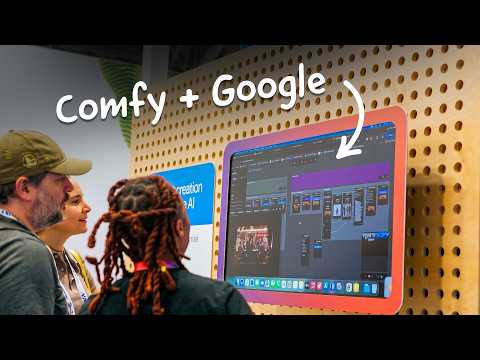
🎬 ComfyUI + Google Models: A Creator-Friendly Agent Workflow
Architectural Summary
This architectural overview highlights Google Cloud's integration of Gemini, Veo, and Imagen models with Avid and ComfyUI to deliver secure, agentic workflows for media production. The framework details how multimodal search and generative AI pipelines are orchestrated on Google Cloud compute infrastructure, streamlining video rendering, editing, and creative asset management.
Firebase Genkit Gemini AI Agents
🎬 Developer Keynote (Google I/O '24)
Architectural Summary
The Google I/O 2024 Developer Keynote details key advancements in building agentic workflows using Firebase Genkit and Gemini 1.5 Pro, establishing modern paradigms for orchestrating AI agents in cloud-native architectures. It also introduces client-side rendering breakthroughs with Flutter's Impeller engine ('Antigravity') and highlights decentralized edge computing via built-in Gemini Nano integration across Chrome and Android platforms.
Android Gemini AI
🎬 What's new in Android development tools
Architectural Summary
This session outlines the latest developer tool advancements in Android Studio, highlighting Gemini AI integrations that accelerate mobile development workflows across modern Android APIs. It showcases how cloud-connected AI capabilities and intelligent tooling enhance developer velocity, which is critical for scaling cloud-native mobile applications and modern CI/CD pipelines.
Mobile Cloud Integration AI Agents
🎬 What's new in Android
Architectural Summary
This session outlines the architectural evolution in Android 17, highlighting advancements in Jetpack Compose, performance optimizations, and the integration of client-side agentic automation. For cloud-native environments, this shifts the paradigm toward edge-to-cloud coordination, requiring backend architectures to seamlessly ingest, secure, and support high-frequency orchestrations driven by autonomous mobile AI agents.