AI Engineering: 2026 Skill Stack, Market Analysis and Career Roadmap
Comprehensive industry analysis, 2026 job-market skill benchmarks, role comparisons (AI Engineer vs ML Engineer vs Platform Engineer), 4-pillar dedicated deep-dive tracks, 7-step production learning roadmap, and curated learning resources for building, deploying, and operating real-world AI systems.
- Executive Summary: Why Python Alone Is Not Enough in 2026
- Specialized Deep-Dive Pillar Hubs
- Top Skills Mentioned in AI Engineer Job Postings (2026 Benchmark)
- 2026 Industry Market Data and Macro Trends
- The 2026 AI Engineering Skill Stack (4 Pillars and 20 Core Competencies)
- AI Engineer vs ML Engineer vs Cloud-Native Platform Engineer
- 7-Step AI Engineering Learning Roadmap (Learn, Build, Ship)
- Principal Tools, Model Providers and Foundation Models
- Curated References, Benchmarks and Learning Resources
Executive Summary: Why Python Alone Is Not Enough in 2026
The 2026 Production Shift: From Prompting to Full-Stack AI Systems
AI Engineering has solidified as one of the fastest-growing technical career paths in 2026. However, knowing Python or experimenting with chat interfaces alone no longer qualifies an engineer for production AI roles. Organizations hiring AI Engineers expect software engineering rigor: integrating Large Language Models (LLMs), grounding outputs with enterprise data (RAG and vector databases), orchestrating stateful tools and agents, containerizing services, and operating reliable, observable workloads in cloud and Kubernetes environments.
The difference between learning AI and becoming an AI Engineer is the ability to build, deploy, evaluate, and maintain real-world AI systems in production.
Specialized Deep-Dive Pillar Hubs
Explore each of the four specialized AI Engineering tracks and cross-domain Nubenetes architecture hubs:
| Track / Hub | Core Focus and Principal Tools | Deep-Dive Guide |
|---|---|---|
| 1. Core AI, Python and Models | Async Python (FastAPI, Pydantic), Frontier vs Open-Weight LLMs, PyTorch, PEFT/LoRA, Prompt Defense |
Core AI, Python and Models Stack |
| 2. AI App Development and Frameworks | LangChain / LangGraph, PydanticAI, Google ADK, TypeScript, Vector DBs, SQL (pgvector) |
AI App Development, Agents and Retrieval |
| 3. Production Evals, LLMOps and Observability | Promptfoo, DeepEval, Ragas, Arize Phoenix, LangSmith, OpenTelemetry, CI/CD Prompt Gates |
Production Evals, LLMOps and Observability |
| 4. Cloud AI, Containers and Kubernetes | AWS Bedrock, Azure AI Foundry, Vertex AI, Docker, Kubernetes, vLLM, llm-d, KServe |
Cloud AI, Containers and Kubernetes Deployment |
| Cross-Domain Sister Hubs | Enterprise RAG/OKF, Agent Protocols (MCP/A2A), Cloud Control Planes, and Verified Courses | AI RAG and OKF · AI Agents and MCP · Enterprise AI · AI Courses |
Top Skills Mentioned in AI Engineer Job Postings (2026 Benchmark)
Based on 2026 AI Engineer job-posting skill frequency analysis (“Top Skills Mentioned in AI Engineer Job Postings — 2026: Skills powering production AI applications”, credited to Artificial Intelligence and Claude AI), employer demand spans programming, foundation models, retrieval, cloud infrastructure, and Day-2 operations:
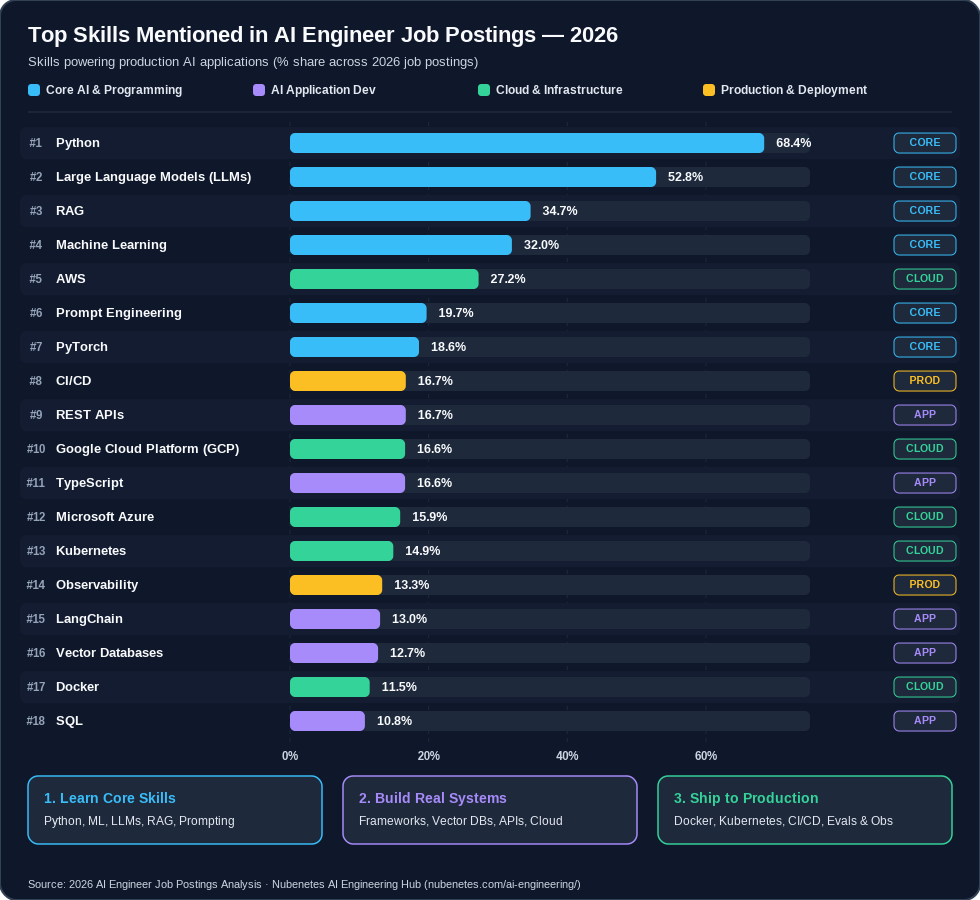
| Rank | Skill | Job Posting Share (%) | Primary Stack Pillar | Deep-Dive Hub |
|---|---|---|---|---|
| 1 | Python | 68.4% | Core AI and Programming | Core AI and Programming |
| 2 | Large Language Models (LLMs) | 52.8% | Core AI and Programming | Core AI and Programming |
| 3 | RAG | 34.7% | Core AI and Programming | Core AI and Programming |
| 4 | Machine Learning | 32.0% | Core AI and Programming | Core AI and Programming |
| 5 | AWS | 27.2% | Cloud and Infrastructure | Cloud and Infrastructure |
| 6 | Prompt Engineering | 19.7% | Core AI and Programming | Core AI and Programming |
| 7 | PyTorch | 18.6% | Core AI and Programming | Core AI and Programming |
| 8 | CI/CD | 16.7% | Production and Deployment | Production and Deployment |
| 9 | REST APIs | 16.7% | AI Application Dev | AI Application Dev |
| 10 | Google Cloud Platform (GCP) | 16.6% | Cloud and Infrastructure | Cloud and Infrastructure |
| 11 | TypeScript | 16.6% | AI Application Dev | AI Application Dev |
| 12 | Microsoft Azure | 15.9% | Cloud and Infrastructure | Cloud and Infrastructure |
| 13 | Kubernetes | 14.9% | Cloud and Infrastructure | Cloud and Infrastructure |
| 14 | Observability | 13.3% | Production and Deployment | Production and Deployment |
| 15 | LangChain | 13.0% | AI Application Dev | AI Application Dev |
| 16 | Vector Databases | 12.7% | AI Application Dev | AI Application Dev |
| 17 | Docker | 11.5% | Cloud and Infrastructure | Cloud and Infrastructure |
| 18 | SQL | 10.8% | AI Application Dev | AI Application Dev |
Rounding Out the 2026 Top 20: Evals and Agent Protocols
While the 18 skills above represent the primary job-posting frequency breakdown, 2026 industry hiring benchmarks highlight two additional production differentiators that complete the 20-skill modern AI Engineering stack: Automated Evaluation Harnesses (Evals) (Production Evals and Observability) and Agentic Interoperability Protocols (MCP and A2A) (AI Agents and MCP).
2026 Industry Market Data and Macro Trends
Cross-referencing the job-posting breakdown with major 2026 industry reports reveals why full-stack production skills command a steep market premium:
| Industry Benchmark / Source | Key 2026 Finding | Engineering Implication |
|---|---|---|
| PwC AI Jobs Barometer | Roles requiring generative AI skills carry an average ~56% wage premium over comparable non-AI software roles, alongside a sharp productivity gap in AI-exposed sectors. | Employers pay for verifiable production impact, not basic API wrappers. |
| Stanford HAI AI Index Report | Enterprise AI investment and foundation-model capability continue to outpace organizational evaluation and governance readiness. | Engineers who master Evals, guardrails, and observability bridge the critical enterprise trust gap. |
| LinkedIn Workforce Insights and Tech Hiring Reports | General AI/ML engineering roles show 142%–143% YoY growth (with Agentic AI Engineer niches surging ~280% YoY) and a 3.2:1 open-role-to-qualified-candidate gap. | Most successful AI Engineers transition from backend, full-stack, or data engineering with 3+ years of software fundamentals. |
| GitHub Octoverse | Over 40% of pull requests in agent-enabled workflows start from AI-generated drafts; strongly typed languages (TypeScript, Python with Pydantic) act as guardrails for LLM code generation. | Developers are shifting from manual syntax writers to architects, orchestrators, and verifiers. |
| Stack Overflow Developer Survey | High daily AI tool adoption coexists with a persistent AI Trust Gap — “almost right, but not quite” code creates verification bottlenecks. | Deep debugging, system design, and automated CI/CD testing remain irreplaceable human skills. |
The 2026 AI Engineering Skill Stack (4 Pillars and 20 Core Competencies)
The modern AI Engineering stack organizes into four interconnected layers — moving from model and language fundamentals to cloud-native production operations:
flowchart TD
    P1["1. Core AI and Programming<br/>Python, LLMs, ML, RAG,<br/>Prompt Eng, PyTorch"] --> P2["2. AI Application Dev<br/>LangChain, Vector DBs,<br/>REST APIs, SQL, TypeScript"]
    P2 --> P3["3. Cloud and Infrastructure<br/>AWS, GCP, Azure,<br/>Docker, Kubernetes"]
    P3 --> P4["4. Production and Ops<br/>CI/CD, Observability,<br/>Evals, MCP and Guardrails"]
- Pillar 1 — Core AI, Python and Models Stack: Production async Python (
asyncio,FastAPI,Pydantic), LLM APIs, embeddings, classical ML, prompt engineering, and PyTorch fine-tuning (PEFT / LoRA). - Pillar 2 — AI Application Development and Frameworks: Stateful orchestration (
LangChain,LangGraph,PydanticAI,Google ADK), vector databases (Qdrant,Weaviate,pgvector), REST/SSE streaming APIs,SQL, andTypeScript. - Pillar 3 — Cloud AI, Containers and Kubernetes Deployment:
AWS,GCP,Azuremanaged AI control planes alongside multi-stageDockerimages,KubernetesGPU scheduling, andvLLM/KServe/llm-d. - Pillar 4 — Production Evals, LLMOps and Observability: Automated
Promptfoo/DeepEval/Ragaseval harnesses,OpenTelemetry/Arize Phoenix/LangSmithtracing, and CI/CD prompt regression gates.
AI Engineer vs ML Engineer vs Cloud-Native Platform Engineer
Understanding where the AI Engineer sits relative to adjacent roles prevents unfocused study:
| Dimension | AI Engineer | ML Engineer | Cloud-Native AI / Platform Engineer |
|---|---|---|---|
| Primary Mission | Build reliable, user-facing products powered by LLMs, RAG, and agents | Train, fine-tune, quantize, and optimize model weights and inference | Build and operate scalable GPU clusters, Kubernetes platforms, and CI/CD |
| Core Stack | Python (FastAPI, Pydantic), TypeScript, RAG, Vector DBs, LangGraph, Evals |
PyTorch, CUDA, LoRA/QLoRA, DeepSpeed, Ray, Triton, Feature Stores | Kubernetes, Docker, Terraform/OpenTofu, GPU Operator, vLLM, llm-d, OpenTelemetry |
| Model Interaction | Frontier APIs + open-weight endpoints + prompt/tool orchestration | Custom training, pre-training, RLHF/DPO, model compression | Multi-tenant model serving gateways, autoscaling, KV-cache routing |
| Observability Focus | Token cost, latency, agent trace steps, hallucination/eval scores | Model drift, data drift, GPU memory, throughput (tokens/sec) | Cluster SLOs, GPU utilization/goodput, FinOps, pod reliability |
7-Step AI Engineering Learning Roadmap (Learn, Build, Ship)
Do not try to learn all 20 skills simultaneously. Follow this sequential progression aligned with the three career milestones (Learn Core Skills, Build Real Systems, Ship to Production):
flowchart LR
    subgraph M1["Stage 1: Learn Core Skills"]
        S1["1. Python and<br/>SW Fundamentals"] --> S2["2. ML and LLM<br/>Fundamentals"]
        S2 --> S3["3. RAG, Embeddings<br/>and Prompting"]
    end
    subgraph M2["Stage 2: Build Real Systems"]
        S4["4. Agent Frameworks<br/>LangChain / ADK / MCP"] --> S5["5. APIs, SQL, VecDBs<br/>and Cloud Platforms"]
    end
    subgraph M3["Stage 3: Ship to Production"]
        S6["6. Docker and<br/>Kubernetes Deploy"] --> S7["7. CI/CD, Evals<br/>and Observability"]
    end
    M1 --> M2 --> M3
- Master Python and programming fundamentals: Async I/O, Git, testing, typing (
Pydantic), and clean modular design. - Understand Machine Learning and LLM fundamentals: How embeddings, attention/transformers, tokenization, and inference parameters work.
- Learn RAG, embeddings, and prompt engineering: Build a grounded retrieval pipeline with chunking, hybrid search, and citations.
- Build AI applications using frameworks: Implement tool-calling, structured outputs, and stateful agent workflows using LangChain/LangGraph, PydanticAI, Google ADK, or MCP.
- Learn APIs, databases, and cloud platforms: Wrap your agent in a streaming FastAPI or TypeScript REST service backed by SQL, a Vector DB, and AWS/GCP/Azure.
- Use Docker and Kubernetes to deploy applications: Containerize your stack and deploy reliably with resource limits, secrets management, and autoscaling.
- Understand CI/CD, monitoring, and observability: Add automated Evals, OpenTelemetry / Arize Phoenix / LangSmith tracing, cost guardrails, and CI/CD pipelines.
Principal Tools, Model Providers and Foundation Models
Because foundation models, orchestration SDKs, and evaluation harnesses evolve rapidly, AI Engineers track the canonical reference stack across six categories (monitored continuously via curation_sources.yaml):
| Layer | Principal Providers, Models and Tools |
|---|---|
| Frontier Model Providers | OpenAI (GPT / o-series), Anthropic (Claude), Google DeepMind / Gemini, Mistral AI |
| Open-Weight Models and Inference | Hugging Face Hub (Llama, DeepSeek, Qwen, Gemma, Mistral), vLLM, SGLang, LiteLLM, Ollama |
| Application and Agent Frameworks | LangChain, LangGraph, PydanticAI, FastAPI, Google ADK, Microsoft Agent Framework |
| RAG and Vector Databases | Qdrant, Weaviate, pgvector, LlamaIndex, Haystack |
| Evals and AI Observability | Arize Phoenix, Promptfoo, DeepEval, Ragas, LangSmith, OpenTelemetry |
| Cloud AI and Kubernetes Runtime | Azure AI Foundry, Amazon Bedrock, Google Vertex AI, Red Hat OpenShift AI, KServe, KAITO |
Curated References, Benchmarks and Learning Resources
- (2026) Roadmap.sh: AI Engineer Roadmap 🌟 - Interactive community standard roadmap covering foundation model APIs, RAG, vector databases, prompt engineering, and production AI application architecture.
- (2026) AI Engineering: Building Applications with Foundation Models (Chip Huyen, O’Reilly) 🌟 - Definitive engineering blueprint covering the modern AI stack, RAG, fine-tuning, agentic workflows, evaluation methodologies, and latency/cost optimization.
- (2026) Latent Space: The Rise of the AI Engineer (swyx and Alessio Fanelli) 🌟 - Seminal industry essay defining the AI Engineer discipline as software engineers building production products on top of foundation models.
- (2026) Anthropic: Building Effective Agents 🌟 - Essential architectural guide distinguishing deterministic workflows (prompt chaining, routing, parallelization) from autonomous tool-using agents in production.
- (2026) PwC Global AI Jobs Barometer 🌟 - Global labor-market study analyzing millions of job postings, demonstrating AI skill wage premiums and productivity acceleration.
- (2026) Stanford HAI: AI Index Report 🌟 - Annual empirical benchmark tracking AI research, enterprise investment, technical performance, and global labor-market trends.
- (2026) GitHub Octoverse 🌟 - Annual developer ecosystem report documenting the rapid rise of AI-assisted pull requests, agent workflows, and typed language adoption.
- (2026) Stack Overflow Developer Survey 🌟 - Global developer survey quantifying daily AI tool adoption, language preferences, and the production AI verification/trust gap.
- (2026) Nubenetes AI Courses and NVIDIA DLI/Academy Hub 🌟 - Curated 2026 matrix of free and paid hands-on AI courses (NVIDIA Academy, Hugging Face LLM Course, Anthropic Claude Academy, Google ML Crash Course, DeepLearning.AI).
- (2026) Enterprise AI Platforms: Cloud AI Control Planes vs Kubernetes 🌟 - Nubenetes architectural guide comparing Azure AI Foundry, Amazon Bedrock AgentCore, Google Vertex AI, and Red Hat OpenShift AI.